Anodizing Banner Image

Customization Options

Professional grade anodizing for wear-resistant and perfectly fitted drone parts.

  • Extreme Durability
 Icon

    Extreme Durability

    Toughens surfaces through anodizing to resist scratches and wear.

  • Corrosion Resistance
 Icon

    Corrosion Resistance

    Our anodizing seals aluminum against moisture and environmental damage.

  • Precision Fitment
 Icon

    Precision Fitment

    Ensures tight tolerances for complex anodizing drone assembly requirements.

  • Professional Finish
 Icon

    Professional Finish

    Delivers vibrant, UV-resistant anodizing colors that will never fade.
Surface Finishe Intro Image

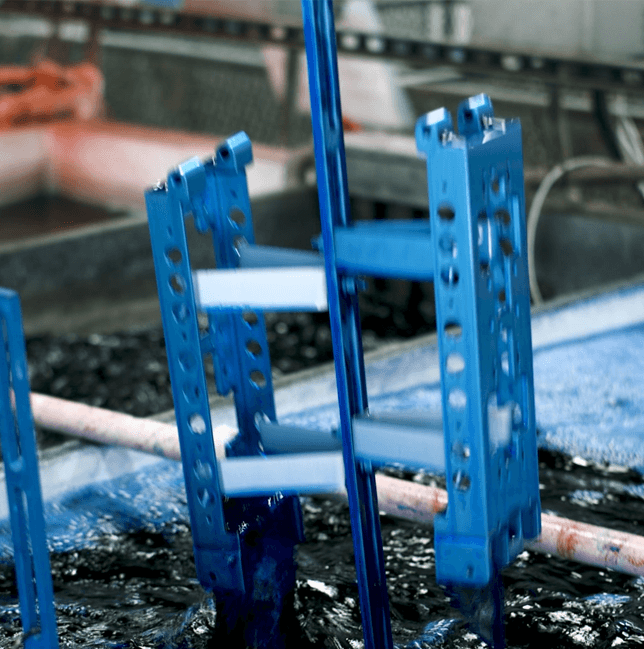
Our anodizing ensures UAV longevity by providing vital corrosion resistance and surface hardness for aluminum structures. Key applications include drone frames, motor mounts, landing gear, and gimbal components.

We specialize in Mil-Spec Type II and Type III hard anodizing, optimized for 6061 and 7075 aluminum alloys. Our team employs precision masking to maintain tight tolerances on bearing bores and protect electrical grounding points. Combined with bead blasting and custom color matching, we ensure durable, high-performance finishes that meet strict engineering standards.

Request a Quote

Anodizing Specifications & Options

Anodizing Types
We execute Type II (Sulfuric) and Type III (Hardcoat) anodizing per MIL-A-8625 standards. Our process achieves coating thicknesses from 15µm to 50µm+, providing the exact surface hardness and density required for high-stress UAV environments.
Surface Roughness
We meticulously manage pre-treatments and etching times to maintain specified Ra values as low as 0.4μm. This ensures optimal aerodynamic performance and a consistent matte or glossy texture across all drone aerodynamic surfaces.
Dimensional Tolerance
To ensure critical CNC bores and threads meet final specs, we calibrate immersion times to control oxide growth within ±5μm. This precision management accounts for the 50% penetration/50% growth rule of the anodic layer, guaranteeing perfect assembly fitment.
Color Matching
Utilizing spectrophotometer testing and Delta E (ΔE) control < 1.0, we guarantee near-perfect color uniformity. Our UV-stable dyes ensure that whether it’s a batch of 10 or 1,000, your brand colors remain consistent and fade-resistant.
  • Anodizing Types
 Featured Image
  • Surface Roughness Featured Image
  • Dimensional Tolerance
 Featured Image
  • Color Matching Featured Image

Process Control & Quality Assurance

  • Cleaning & Prep Icon

    Cleaning & Prep

    Remove oils and residues for uniform oxide formation.

  • Controlled Anodizing Icon

    Controlled Anodizing

    Stable parameters for consistent thickness and appearance.

  • Advanced Sealing  Icon

    Advanced Sealing

    Improves corrosion performance and durability.

  • Quality Verification Icon

    Quality Verification

    Precise thickness checks to meet tight tolerances.

Custom Now

FAQs about Anodizing Service

How do you control dimensional growth during the process?
We calibrate our anodizing immersion times to manage the 50% surface buildup, ensuring your high-precision CNC drone components maintain their specified engineering tolerances.
Which anodizing type do you recommend for high-wear parts?
We provide Type III Hardcoat anodizing for structural components like motor mounts, creating a dense, wear-resistant layer that far exceeds the durability of standard finishes.
Can you protect specific areas from the anodizing layer?
Our team applies precision masking before anodizing to preserve raw metal on grounding points, ensuring your drone electronics maintain perfect electrical conductivity.
How do you guarantee color uniformity for large orders?
We utilize digital spectrophotometers and stabilized chemical baths during anodizing to ensure that every frame and arm matches your brand’s exact color profile perfectly.
What measures do you take to prevent part damage?
We use custom-designed racking systems during anodizing to prevent contact marks and vibration damage, ensuring that delicate, thin-walled drone parts arrive in pristine condition.
How do you verify the quality of the final oxide layer?
Every batch undergoes eddy-current thickness testing and seal integrity checks after anodizing to confirm that the protection meets aerospace-grade durability and corrosion standards.