Polishing Banner Image

Customization Options

Protecting Critical UAV Components with Wear-Resistant Coatings and Exact Tolerances.

  • Aerodynamic Efficiency Icon

    Aerodynamic Efficiency

    Reduces air drag by up to 15%.

  • Friction Reduction Icon

    Friction Reduction

    Lowers surface friction by nearly 40%.

  • Surface Smoothing Icon

    Surface Smoothing

    Achieve ultra-smooth finishes below 0.05 µm Ra.

  • Enhanced Fatigue Life Icon

    Enhanced Fatigue Life

    Removes surface stress risers to prevent cracks.
Surface Finishe Intro Image

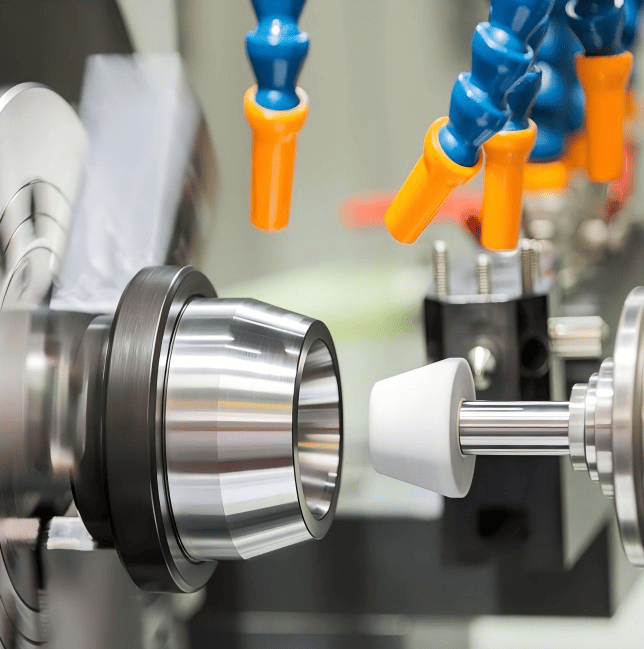
Our polishing service delivers mirror-like finishes for camera gimbals, aerodynamic fairings, and motor housings, ensuring sleek aesthetics and peak performance.

We offer multi-stage polishing tailored for engineers, achieving surface roughness as low as 0.05 µm Ra. Our process eliminates microscopic stress risers and surface pits, enhancing structural fatigue life and reducing drag—essential for high-speed drone frames and precision-fit mechanical assemblies.

Request a Quote

Advanced Specs & Options

Precise Roughness Control
We deliver specific Ra finishes as low as 0.05 µm, ensuring your moving drone parts meet exact friction and performance specs.
Sharp Edge Preservation
Our specialized techniques prevent "washout," maintaining the geometric integrity of your critical CNC features and sharp corners during polishing.
Fatigue Life Enhancement
By removing microscopic surface pits, our polishing service eliminates stress risers, significantly increasing the structural durability of aluminum drone frames.
Optical Surface Consistency
We provide uniform high-luster finishes that manage light reflectivity and thermal emissivity for sensitive sensor housings and camera mounts.
  • Precise Roughness Control Featured Image
  • Sharp Edge Preservation Featured Image
  • Fatigue Life Enhancement Featured Image
  • Optical Surface Consistency Featured Image

Process Control & Quality Assurance

  • Roughness Measurement  Icon

    Roughness Measurement

    We verify Ra values using digital profilometers.

  • Geometric Accuracy Check  Icon

    Geometric Accuracy Check

    We ensure polishing hasn't rounded critical edges.

  • Visual Defect Inspection  Icon

    Visual Defect Inspection

    We scan for pits, scratches, or clouds.

  • Specular Reflectivity Testing  Icon

    Specular Reflectivity Testing

    We measure light reflection for mirror finishes.

Custom Now

Frequently Asked Questions

How do you prevent dimensional "washout" on tight-tolerance features?
We use precision-controlled mechanical laps and custom masking to ensure that polishing removes only microns of material, preserving the geometric integrity of your critical mating surfaces and sharp corners.
What is the lowest Ra value your polishing service can consistently achieve?
Our multi-stage process can reach a surface roughness as low as 0.02 µm Ra, which is essential for reducing friction in high-speed rotating motor components or gimbal assemblies.
Can you ensure surface uniformity across complex, non-planar geometries?
By utilizing five-axis centrifugal finishing and specialized media, we provide a uniform polishing finish across complex drone frames and curved aerodynamic fairings that manual methods cannot match.
How does your polishing process affect the fatigue life of aluminum parts?
Our process is designed to eliminate microscopic "notches" or stress risers created during CNC machining, which significantly delays crack initiation and extends the operational lifespan of high-stress structural components.
Do you offer different levels of reflectivity for optical sensor housings?
Yes, we provide calibrated finishes ranging from satin (diffuse) to high-mirror (specular) to meet your specific requirements for thermal emissivity and light management for onboard sensors.
Will the heat generated during polishing cause material warping?
We use liquid-cooled wet polishing techniques to manage thermal energy, ensuring that thin-walled drone components remain dimensionally stable and free from heat-induced distortion.